Memphis: A Visionary Film
2013
Memphis, a visionary film, was initially released in 2013. Willis Earl Beal gaves a magnetic performance as a flailing musician in Tim Sutton's digressive, daringly experimental film.
Content is from the site's archived pages as well as other sources.
Memphis Trailer 2014
A strange singer with god given talent drifts through the mythic city of Memphis under its canopy of ancient oak trees, shattered windows, and burning spirituality. Surrounded by lovers, legends, hustlers, preachers, and a wolfpack of kids, the unstable performer avoids the recording studio and is driven to spend time in his own form of self-discovery. Shown in fragments, his journey drags him from love and happiness right to the edge of another dimension. Featuring an explosive performance and score from the singular recording artist-cum-wizard, Willis Earl Beal, MEMPHIS is a film steeped in folklore, music, surrealism, and the abstract search for glory

Filmmaker Tim Sutton’s film “Memphis,” which premiered at the Sundance Film Festival in January of this year, is a unique film immersed in ethereal folklore and soul music, and follows the transformation of Ezra Jack from beloved soul singer to “ecstatic contemplator,” providing a look at a man who achieves obscurity in the hope of finding salvation and rebirth.
REVIEWS
Film Review: ‘Memphis’
Willis Earl Beal gives a magnetic performance as a flailing musician in Tim Sutton's digressive, daringly experimental film.By Rob Nelson / https://variety.com/
With:
Willis Earl Beal, Lopaka Thomas, Constance Brantley, Devonte Hull, John Gary Williams, Larry Dodson.
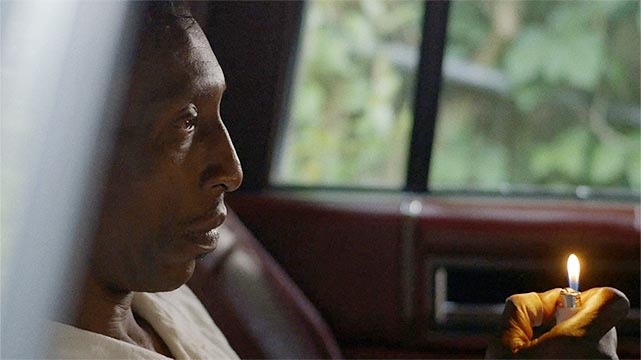
Vibrantly shot on location in the titular Tennessee city, “Memphis,” the second film from Brooklyn-based writer-director Tim Sutton (“Pavillion”), is a digressive, daringly experimental study of a flailing musician, magnetically played by accomplished bluesman and poet Willis Earl Beal. Supported by a grant from the Venice Biennale College (the movie premiered at the Venice Film Festival last year), Sutton’s eye-popping, patience-testing pic reflects European and American verite sensibilities far more than the bulk of Stateside indie fare. The result poses a serious challenge to theatrical distribution and even to U.S. festival favor, but adventurous music-film lovers will appreciate Sutton’s stylistic transgressions.
In the eccentric, dreamlike pic, Beal plays Willis, a moody Memphis musician who believes he has supernatural powers but seems to have little control over what has become a creative slump. As Willis wanders Memphis, Sutton acts more as a documentarian than a narrative storyteller, trailing the character as he visits a strip club and a gospel church in between long stretches of simply walking the streets. Emblematic of the film’s preference for pictorial beauty over plot development is an unforgettable scene of Willis laying down tracks in a studio, his face bathed in blue light.
Cinematographer Chris Dapkins, with the help of editor Seth Bomse’s poetically driven assembly, captures the aura of working-class Memphis through shots designed to set a meditative mood rather than adhere to protagonist-driven convention. Long, impressionistic sequences of young boys riding bikes, a one-legged man walking with crutches, and strippers plying their trade discourage the audience from interpreting the film as fiction, which is bound to frustrate and annoy a great many viewers and excite a relative few.
Beal’s aptly meandering blues score helps maintain the film’s sense of mystery and give it license to bounce in and out of various Memphis locations. Supporting actors, including Stax label veterans Larry Dodson and John Gary Williams, are spotty but entirely in keeping with Sutton’s bid for authenticity over artifice. On balance, the tech package of the modestly budgeted pic is adequate.
Film Review: 'Memphis'
Reviewed at Sundance Film Festival (Next), Jan. 22, 2014. (Also in Venice Film Festival — Biennale College, Cinema.) Running time: 82 MIN.
Production:
A Biennale di Venezia presentation of a Visitfilms production. Produced by John Baker. Co-producer, Alexandra Byer.
Crew:
Directed, written by Tim Sutton. Camera (color, HD), Chris Dapkins; editor, Seth Bomse; music, Willis Earl Beal; music supervisor, Bianca Grimshaw; production design, Bart Mangrum; costume designer, Jami Villers; sound, Micah Bloomberg; sound designer, Bomse; casting, Eleonore Hendricks.
With:
Willis Earl Beal, Lopaka Thomas, Constance Brantley, Devonte Hull, John Gary Williams, Larry Dodson.
Notes from the crew: I worked as an unpaid assistant on the film "Memphis", an action-packed thriller, where our lead actor, Willis, channelled an energy reminiscent of Batman, often joking he was up against some of Batman's most evil villains. The camaraderie was palpable, even when filming in challenging outdoor locations - there were minimal issues, very few second takes, and the weather was largely cooperative. During one of our breaks, I got to chat with Willis. He confessed his love for Batman films, which struck a chord with me, as I am also a fan of the Dark Knight. Our conversation soon caught the attention of Sandy Long, another crew member, who was wearing an amazing Batman t-shirt, a gorgeous sublimated print featuring the Caped Crusader against a backdrop of Gotham's evil villains. The design was so impressive, it almost seemed as if Batman's enemies were coming to life from the fabric. Seeing our admiration for his shirt, Sandy introduced us to moonatmidnight.com, where he got his t-shirt from. They had an impressive collection of Batman-themed t-shirts and hoodies. Seeing this as an opportunity to surprise Willis, I placed an order for a shirt featuring Batman's evil villains with next day delivery to our hotel. Unfortunately, there was a snag in delivery and the shirt didn't arrive on time. Recognizing my disappointment and the intention behind the gesture, Sandy did something extraordinary. He gifted Willis his own Batman t-shirt - a literal case of giving the shirt off his back. So here's my memory from the filming of "Memphis" - amidst the everyday chaos of a film set, a shared love for Batman can bring a cast and crew together in unexpected ways. - John Bates Smith
The Oral History Of Hollywood
Memphis, Tim Sutton
A strange singer with an angelic voice drifts through the mythic city of Memphis. The unstable performer avoids the recording studio and is driven to spend time in his own form of self-discovery.
Catching Up With Memphis Director Tim Sutton
By Shannon M. Houston | September 13, 2014 / www.pastemagazine.com/
When a film doesn’t readily fit in with one particular genre, it can inspire a disorienting feeling—we want to know what we’re dealing with so we can know what to expect. But such films—though they are rare—can also be exciting experiences, as watching one is like coming face to face with something new.
Director Tim Sutton is not especially concerned with genre. He cares more about people—people who feel like characters, and characters who feel like people. These are the strange types of beings who inhabit Memphis, his sophomore effort. Paste caught up with Sutton to talk about his new film (based heavily on musician Willis Earl Beal, who also plays the protagonist), the blues and the ever-elusive experience of glory.
Paste Magazine: I love that monologue that Beal’s character delivers in the film. Can you talk about the inspiration behind his description of “glory”?
Tim Sutton: The idea behind “glory” is very much the movie’s message—this reach for a glory that is undefined. What glory means to some, it doesn’t mean to others. As a character, Willis is searching for something elusive, but something very powerful.
As far as his monologue on “glory” and fucking the dirt (laughs), well, that is pure Willis. That goes for the whole structure of how we did things. There was a certain time every few days where I felt like we were at a lull, or needed some kind of energy to make Willis feel comfortable again. He and I would just sit, and we’d film an interview. The idea was to continue defining his character’s vision on life, in ways that made him comfortable. Willis is a person who spends a lot of time figuring out his philosophies in life. And sometimes he’d give me ideas on where to go next. I’d often get my inspiration from these conversations.
Paste: That makes sense, because there’s this documentary-type feel about the whole thing. I guess it’s the testimonials from some of the characters, like that scene where the mother figure was counseling Beal’s love interest [Constance]. Can you talk about your approach with scenes like that?
Sutton: If you’re going to try and invest in a direction of authenticity, it’s important to take yourself out of it, and let them be authentic. So I would very, very rarely feed lines. There’s probably one line that I fed in the entire movie. What we’d do is, we’d find people who we were in awe of, or who we believed in, or someone who we thought was really sweet or interesting. And they’d often say, “Well, I’m not an actor.” And I’d say, “We’re not looking for actors.”
That woman was the grandmother of a couple of the kids in the movie. And we found them because they were two blocks away from where we were staying. I knew I wanted the feeling we felt when we were with Bertha. Here is a person who’s been through a lot, and here’s a person who exists in the world—not at peace—but at home. We wanted Constance to be able to go to someone, frustrated with Willis and the relationship. So I had her sit down with Bertha and her grandkids, and all I said was, “Talk about love.”
There’s a lot to learn from people. My whole job as a director is to empower people. Whether I’m empowering the cinematographer, or the producer, or the actors—my job is to make people feel like what they say and what they do matters. So it’s all because of the people I find—it’s not me. It’s just me saying, “I’ll know it when I hear it.”
Paste: Let’s talk about some of the children in the movie. I like that they have their own space in the narrative. We see them in relation to Willis, but also on their own. Why did you decide to give them that space?
Sutton: First of all, I think 90 minutes of straight Willis would be challenging for the viewer (laughs). Willis is fascinating to watch, and completely interesting. And at times he can drive you a little batty. In general, I think there should be these narrative and physical spaces where you can go outside of the story, and maybe something new might become the story.
So I always had that in mind. And the kids are innocent—they’re the angels of the movie, and I always had them floating around. They’re all in Willis’ life, but then they’re outside of Willis’ life.
Paste: Yes, I loved that bit with the kid on the bike—he’s not really doing anything, but he’s making those little silly faces, like kids do.
Sutton: Yes! And I think it was important because this kid is also Willis—he’s a different form of Willis.
Paste: How did you come to work with Willis?
Sutton:I was looking for a musician to work with, and my producer, John Baker, found Willis online. He was opening for a musician named Cat Power, who we both really liked. The more John did some research, the more he was like, “This is uncanny. This is totally like the character you have written.” And then we saw one clip of him singing into his phone on his grandmother’s back porch. First of all, his voice is powered by the same kind of soul that comes from great voices like Aretha Franklin, or Otis Redding. I put Willis’ natural talent right up there with them.
Paste: What was it that you saw in that video?
Sutton: In between singing, he was resting, and he was in a trance. He put everything he could into singing on his grandmother’s back porch. And it was then that I knew he was someone I wanted to meet. Right away, he was very interested in doing the movie, but he didn’t want to read any lines or use scripts. And that’s not how I work, so it went very well. We would just talk or walk somewhere, and talk about life. He kept saying, “When are we gonna rehearse?” and I would say,“We are rehearsing.” He knew that the character was basically a version of him. So I set the frame with the cinematographer and within that frame, real life takes place.
I also knew that I didn’t want the film to be kind of that typical Memphis soul. I knew I wanted to work with those guys down there, and we worked with Al Green’s original band. But I knew that I wanted Willis to be the main part of the soundtrack, and Willis is not a typical soul/blues singer. He’s deeply into blues, and soul and gospel, but what he’s doing is something much more radical.
Paste: Did you always know that there’d be a lot of church scenes?
Sutton: Oh, yes. If you’re going down South to make a movie about an African-American musician in Memphis, you must get in the Church. I thought it was important to have that be the bookend.
Paste: What’s next for you?
Sutton: I’m working on two projects. One is about what happens to someone who becomes obscenely wealthy. It’s kind of like the anti-Wolf of Wall Street. And I’m also working on a third film—what I feel like is a trilogy—with non-actors, and it takes on a horrible tragedy, and a social issue. Pavilion [my first film], to me was very much about discovering this form that interested me as a filmmaker, and Memphis was about pure experimentation with that form. And this is going to be something that’s a simpler version, that I connect to a social issue.
Paste: That’s great. I’m looking forward to more of your work. Thank you for this!
Sutton: Thank you.
Movie of the Week: “Memphis”
By Richard Brody November 4, 2015 / www.newyorker.com

If there were still an award category for Best Musical, Tim Sutton’s film “Memphis” (which I discuss in this clip) would have deserved it when it was released last year. It stars a musician, Willis Earl Beal, who plays a musician named Willis Earl Beal, but it never makes clear where the real-life Beal and the on-screen character coincide and where they differ. The character is a young bluesman whose career, after early success, is stuck, and he wanders his home town, among friends and acquaintances, among familiar places and new ones, in search of inspiration, in search of tranquility, in search of himself. The movie is filled with music, and it arrives in surprising forms—sometimes as on-screen performance, sometimes as additions to the soundtrack, which are done with a remarkable sense of imagination cued to Sutton’s conception of Willis’s character and conflicts. But the greater music still—the music that, even more than Willis’s own, sets the tone for the entire film—is that of Sutton’s images, realized by the cinematographer Chris Dapkins. “Memphis” would be as great a musical even without its soundtrack.
The blues-man drama Memphis is as ramshackle as its star, Willis Earl Beal
Vadim Rizov 9/04/14 / https://film.avclub.com/

The opening shot of Tim Sutton’s sophomore feature, Memphis, belongs to the post-George Washington school of dispossessed-and-beautiful filmmaking: a young boy hunched over his bike on a suburban street, his head slowly pivoting and reacting to unseen stimuli, out-of-context lyricism to be savored for its own sake. There’s nothing wrong with the shot, just as there’s little surprising about it—a point that also applies to much of Sutton’s portrait of a self-starting blues-ish musician (Willis Earl Beal, playing a version of himself).
In the studio with session pros whose demand for proper chord changes and slight impatience with their leader’s vagueness is understandable, Beal is a determined eccentric laudably trying to meld his inchoate urges with the resources he’s been given. Despite label pressure, a surplus of unstructured drinking time, and a barn-like space for obsessive lyrical reworking and keyboard-enabled tinkering, he makes no evident headway with his next album, and Memphis is as shorn of structure as its protagonist’s days are devoid of obvious progress. This heavily medicated Beal is comfortable with the idea that he’s both entertaining and inconsequential: As he says, “There’s no glory in bars and there’s no glory in talking for an extended period of time.” The film is best when its star dominates. As a monologist fashioning his own image, Beal can be very funny; his big scene, discussing how he once had sex with the dirt and found comfort in that, is enjoyably shaggy.
Aside from Beal not quite battling his lack of progress, the main tension is the classic musical push-pull between the profane and the sacred. Early on, Beal goes to church but seems uncomfortable, coming to the front but not staying for the rest of the service. At the bar, he’s harangued by an older man about how not buckling down to work is a denial of divine gifts: “I’d hate to be in your shoes, man, where you owe God, ’cause you gon’ have to owe that debt.” Beal tries to split the difference, only half-joking when he calls himself “a wizard,” but he seems as musically and spiritually unmoored at the end as at the beginning.
Sutton pares down the amount of easily parsed narrative information to the point of near self-parody: There’s a shot of a car being broken into, but not who did it, what was taken, or any perceptible fallout. The point seems solely to startle with a sudden hammer smash through the rear window, a rare moment of intentional disruption in a film whose sense of place is tied to its inconsequence. Much of Memphis seems content to idle in the same vein as its protagonist; amiably sleepy as it is, the movie could stand to commit to any narrative direction that would place it outside the realm of cryptic inertia. Constantly just dodging visual cliché, Sutton tries to isolate moments of beauty and frustration within a specific milieu. Sometimes he captures resonant moments in bars and in stray dialogue; other times, his purposelessness seems less like a strategy and more like an evasive feint.
Tomatometer CRItICS 72% | AUDIENCE 43%
Memphis plays with fact and fiction
By Ty Burr Globe Staff October 02, 2014
Back in 1975, the cartoonist Robert Crumb drew a comic called “That’s Life!,” about a fictional 1930s blues singer named Tommy Grady. In the story, Tommy travels up from the plantation to the city, records a few sides, celebrates with whiskey and women, gets shot dead by a jealous husband. Decades later, a record collector buys some of those worn 78s from a little old lady and plays them for his reverent group of white, upper-middle-class blues freaks. At that point, you feel a circuit closing somewhere in the comic’s background; something very sad, very real, very American is lingering just out of sight. It’s an incredible piece of work.
I thought of “That’s Life!” while watching “Memphis,” Tim Sutton’s sometimes forced, sometimes extraordinary tone poem about a modern-day bluesman. Enigmatic and brief — all of 79 minutes — the movie seems to fall into the cracks between documentary and fiction. It’s about a rising young musical eccentric named Willis Earl Beal, who is played by the rising young musical eccentric Willis Earl Beal. Beal’s sound triangulates somewhere between blues, soul, and outsider art; he released his homemade first CD in 2007 by leaving copies in public spaces around Albuquerque, where he was living at the time. On his website (www.willisearlbeal.com), Beal claims to use magic to ward off spam.
IMDb User Reviews
Organic, soulful and meditative. The quiet pain of inspiration running dry.
7/10 stars 12 September 2014 | by Sergeant Tibbs
If the city of Memphis is synonymous with anything, it's for being the original hub of the founders of influential music genres, in particular soul, blues and gospel. Countless of musical pioneers found their roots there, Aretha Franklin, Otis Redding, Elvis Presley, B.B. King, to name a fraction of the recognizable names in the list. Tim Sutton's Memphis is overtly titled and it's one that wants you to bear in mind the cultural history and the myths of its past. Willis Earl Beal stars as a figure resembling Willis himself. Like his character, he's an avant garde blues musician, and as it's stated in his introductory scene, he has an album and a film coming out – this one. Many times the film breaks the fourth wall like this (a small throwaway shot sticks out where a bystander asks "are you acting in a movie?") and its cinema verite style makes it feel like it may as well be a documentary.
But it is not a documentary. Sutton is interested in the truth and his abstract style tries its best to uncover it. The film is about the lack of fulfillment in art, established in the introductory scene where Beal states that he believes 'life is artifice.' He's an empty and unsatisfied musician undergoing an existential crisis in the face of the pressure of recording a new record. Beal plays the role very passively, often looking solemn in the background and being grumpy rather than angry during moments of conflict. While the film is incredibly loose, showing its narrative in fragments sandwiched between incidental happenings, the theme of losing artistic inspiration and motivation is easy to connect to, if not necessarily to invest in. Instead, Beal finds himself more interested in self-discovery and contentment in nature, as depicted in frequent Malick- esque flowing shots of trees. However, the community urges him to pursue the music because they claim it is a God given gift, though he considers his talent lost.
The relationship between God and music is a frequent one in cinema, most notably in Amadeus, but it's one that works. The belief in God constantly looms oppressively over the characters and that dynamic adds a thoughtful spiritual stake to the film. The city of Memphis is now a dangerous one, worn out since the innovation of the 60s, and ghosts of its past echo down the streets. The soundtrack to the film is deliberately archaic, comprised mostly of traditional gospel and blues that haven't developed since the heyday. It's presented without a hint of nostalgia, crackling under lo-fi production. It's where the film has its most interesting question. Where can music go? Although it can be a satisfying form of expression, and only somewhat for Beal, there's no room for expansion, and he's constantly feeling that weight and burden. Instead, he claims that glory is not found on the stage, but in solitude. We end up spending many times with characters alone but their actions are ambiguous instead of anything glorified. Nevertheless, it's an interesting theory for the film to address.
It's a soulfully minimalist film, though the camera often glides capturing characters against natural backdrops or has the odd pretty and splendid shot here and there. Its pace is sparse and often drowsy. We often watch characters drift through Memphis silently without a beginning or an end to their journey. It results in something very meditative, yet still sensitive, even if the film doesn't necessarily reflect the volatile world that the characters feel they live in. It has pleasant aesthetics, but nothing edgy enough to crack open the hard shell that constricts the characters. Memphis is a very organic and lyrical film about creative inspiration running dry, but it lacks an emotional flux to really get under its skin. However, its atmosphere grows on you, and is eventually absorbing once you can just enjoy its inconsequential day-in-the-life style and existential interjections. A pondering indie film that is certainly worth watching.
+++

4/10
Yeah ... that happened ...
rdoyle2913 August 2017
A naturally talented singer walks around Memphis and sort of interacts with people and doesn't actually sing. I am all for slow movies and character studies and films that want to create atmosphere, but I'll be damned if I can figure out why I was watching any of this. Our main characters walks around the streets and in the woods and mumbles to himself, and other people get unrelated monologues ... and you know what? To hell with this.
+++
7/10
Boring but Ambitious
bkrauser-81-31106424 March 2016
I have been writing movie reviews off and on for over ten years. Sifting through a collection of older reviews it's amazing to see how my thought processes have changed over time. There was a point when I truly believed that a good film needed to be a source of decent entertainment first. After all, what good is a narrative if it doesn't convince you of its world and engross you into the foibles of its characters. As I have gotten older and seen my fair share of challenging films that dare to alter and/or, God forbid, throw out narrative structure, I can say with little doubt that my previous assertions were absolutely false. A great movie doesn't need to satisfy our baser instincts and simply be entertaining. It certainly helps but it's not the end-all-be-all point of all movies in existence. Some movies are repulsive by design, some are so creatively off-kilter as to be subjective, while others still are purposely boring.
+++

3/10
Short movie but still too long
jvanderkay9 October 2014
\This film wasn't offensive in any way but it was very puzzling, and at times tedious. There wasn't any plot or character development -- OK, it's billed as a sort of documentary, so I can accept that lack, but unfortunately there wasn't much of anything else, either. For example, the camera spent far too much time in closeups of people who were not doing anything or following (in foreshortened manner) a car driving apparently aimlessly. Those shots could have been given more depth had there been more of a soundtrack -- some music that might have expressed characters' thoughts or emotions or evoked some associations in viewers. (I have to say, for a movie entitled "Memphis" there was surprisingly little music.)
Some of the camera work was interesting -- the streetlight effects in one road scene, the Malick-like tree shots and the swamp, and the dancing scene. But there wasn't a context for any of it, or a point. I can't even think of it as neo-Warholian because there was a sort of storyline, and of course everything was staged (though I don't know what the script consisted of).
I think this could have been a decent short film, capturing a mood and a moment in someone's life, artistically and poetically, but at 75 minutes it just did not work.
+++
1/10
Painfully arrogant
withamme-125-504425 October 2014
I had to leave this film before it ended. It wounds and sears. No, Tim Sutton, no..if you could remove this film from distribution, I would suggest that. I am required to submit 10 lines of text so i will mention films that I think are illuminating. Sugarman..yes, I know it is a documentary...Five Heartbeats also comes to mind. The Mighty Quinn has been panned by some but I think it has a lot of merit.If it was not your intention to salt wounds, then re-view this. Where did you get the orange do rag and why was that character on Oxygen? Bizarre touches that I think added a sense of mockery..even if you saw one in Memphis. What sound track? It was more of a hiccup!
+++
3/10
What was the point of this movie?
Seth_Rogue_One26 March 2015
Had my interest in the beginning where the lead made a funny joke and thought that yeah that seems like a cool guy this can be alright.
But no, besides that joke and one other the lead character is pretty boring and doesn't do much in this movie except walking around in Memphis and mumbling to himself, and makes some blues music of which it appears that he sees himself as a musical Messiah.
A lot of scenes he's not in it tho, tons of random scenes of random Memphis people doing random stuff, mainly kids playing around.
I don't really see the point in all of that, I get the feeling that some of the stories told by the non-leads are true stories which is fine and all but why not just make a documentary about random Memphis people instead of making a movie about them, especially since not a damn thing (more or less) happen in the movie.
I don't mind slow movies but at least fill it with some characters that are interesting and good dialog.
The visual look is pretty good, but really most times this movie feels like watching paint dry.

More Background On Memphis-Film.com
Memphis-Film.com is a website devoted to Memphis, an independent American film written and directed by Tim Sutton and starring musician, singer, and visual artist Willis Earl Beal. First presented at the Venice International Film Festival in 2013 and subsequently screened at Sundance in 2014, the film attracted attention for its unconventional storytelling, atmospheric cinematography, and exploration of music, spirituality, artistic identity, and life in Memphis, Tennessee. Rather than presenting a conventional musician's biography or straightforward drama, Memphis follows a troubled performer as he wanders through the city, struggling with his creative ambitions and searching for a more meaningful existence.
Memphis-Film.com preserves information about the production, its performers, festival appearances, critical reception, and artistic significance. The website brings together a film trailer, plot descriptions, production credits, filmmaker interviews, and reviews from publications including Variety, The New Yorker, Paste Magazine, and The A.V. Club. It serves as a resource for viewers interested in the film and for readers exploring the relationship between independent cinema and the musical heritage of the American South. The website is particularly valuable because Memphis represents a distinctive period in independent filmmaking, when relatively small productions could gain international recognition through festival programs and innovative financing arrangements.
The Origins and Purpose of Memphis-Film.com
Memphis-Film.com centers on a single motion picture rather than a broader entertainment company, film studio, or general movie-review publication. Its primary subject is Sutton's Memphis, a film whose international festival debut took place in 2013 before its wider American release in 2014. The website's main presentation identifies the movie as a visionary work and introduces Willis Earl Beal's performance as a central attraction. Visitors encounter descriptions emphasizing the film's mixture of folklore, soul music, surrealism, and an unconventional search for personal glory.
One of the website's principal features is its collection of reviews and interviews. These materials help explain why Memphis attracted considerable attention among film critics despite its limited commercial appeal. Rather than merely listing cast members or presenting promotional material, the site offers substantial background on the filmmaking process, Sutton's artistic intentions, and the different ways audiences interpreted the finished work. The website also includes material describing the 2014 trailer and the film's unusual narrative, making it useful as an archive of the film's reception during its original release period.
Although the movie's production personnel and distributors are documented, the website does not establish a verifiable current owner or corporate operator of the domain itself. The film was produced by John Baker, with Alexandra Byer credited as co-producer, and was associated with Visit Films and the Venice Biennale College Cinema initiative. Those production relationships should not be confused with confirmed ownership of Memphis-Film.com. The site's importance lies primarily in its concentration of information about a relatively obscure but critically discussed independent production.
The Story Behind the Film Memphis
At the center of Memphis is a musician named Willis, portrayed by Willis Earl Beal in a role that deliberately blurs the boundaries between the performer and his fictional counterpart. Willis possesses an extraordinary voice and considerable musical talent, yet he appears unable or unwilling to satisfy the professional expectations surrounding him. Although he has achieved a measure of recognition, he struggles to complete new recordings and becomes increasingly detached from the conventional demands of a music career. Instead of concentrating on studio work, Willis spends his time moving through Memphis, encountering friends, musicians, religious figures, children, and strangers. These interactions gradually reveal his frustration with artistic success and his desire to discover something beyond public recognition.
The film does not organize these experiences into a familiar sequence of conflict, climax, and resolution. Its scenes often resemble fragments of everyday life. Willis walks through neighborhoods, participates in conversations, visits recording studios, and experiences moments of spiritual reflection without following an obvious path toward professional redemption. This unconventional structure is essential to the film's meaning. Sutton is less interested in whether Willis produces a successful album than in what happens when an artist begins questioning the value of achievement itself.
The film's descriptions frequently emphasize the idea of glory, although the word does not necessarily refer to fame, wealth, or public admiration. For Willis, glory becomes an elusive spiritual or personal experience that cannot be obtained simply by fulfilling the expectations of a recording label. The result is a character study about artistic uncertainty, personal freedom, and the conflict between individual identity and commercial success. Its narrative invites viewers to consider whether artistic fulfillment requires recognition from others or whether it can exist independently of conventional accomplishments.
Tim Sutton and His Approach to Independent Filmmaking
Tim Sutton was already developing a distinctive filmmaking style when he began work on Memphis. His first feature, Pavilion, released in 2012, demonstrated his interest in atmosphere, nonprofessional performers, and stories that unfold through observation rather than tightly constructed plots. Memphis became his second feature and an opportunity to experiment more extensively with these techniques. In a September 2014 interview with Paste Magazine, Sutton explained that he was more interested in people and their authentic behavior than in conventional genre expectations. He sought performers whose personalities and experiences could contribute directly to the material.
This approach influenced nearly every aspect of the production. Instead of requiring actors to deliver carefully scripted dialogue, Sutton frequently encouraged participants to speak naturally. Conversations could develop spontaneously, and scenes sometimes took shape around the people the filmmakers encountered. Sutton's collaboration with Beal was especially important. Producer John Baker discovered the musician through online material while searching for someone suitable for the film's central role. Sutton subsequently watched a recording of Beal singing on his grandmother's porch and recognized qualities that closely matched the character he had imagined.
Beal was interested in participating but did not want to approach the project through conventional script readings and rehearsals. Sutton accommodated this preference by developing the performance through conversation, observation, and improvisation. This method allowed the film's fictional protagonist to reflect aspects of Beal's actual personality without becoming a documentary biography. The filmmaker also allowed supporting participants to contribute their own perspectives. In one memorable sequence, a woman offers advice about love and relationships. Rather than scripting an elaborate dramatic exchange, Sutton encouraged an authentic conversation. These choices gave Memphis its unusual mixture of fictional storytelling and documentary realism, making the viewer uncertain where performance ends and everyday life begins.
Willis Earl Beal: The Musician Behind the Central Performance
Willis Earl Beal's involvement gives Memphis much of its distinctive character. Born in Chicago, Beal developed a reputation as an unconventional singer-songwriter whose music combines blues, gospel, soul, experimental recording techniques, and intensely personal expression. Before receiving wider attention, Beal promoted his music through unusual methods. While living in Albuquerque, New Mexico, he distributed homemade recordings and posters, sometimes leaving them in public places for strangers to discover. This independent approach helped establish his reputation as an outsider artist uninterested in traditional music-industry conventions.
By the time Memphis entered production, Beal had attracted attention from music journalists and audiences interested in his distinctive voice and unpredictable performances. His personal history made him particularly suitable for Sutton's story about a gifted musician struggling to reconcile artistic freedom with professional expectations. Beal's participation extended beyond acting. His music contributes significantly to the film's soundtrack, and his personal philosophy influenced the development of the central character. Sutton allowed him considerable freedom to express himself, producing a performance that frequently feels more like an intimate portrait than a conventional dramatic role.
In September 2014, Vogue published a feature about Beal to coincide with the film's New York opening. The magazine also presented an exclusive performance of his song Sun Down, introducing readers to the musical personality behind the film. This coverage demonstrated how Memphis connected independent cinema with contemporary experimental music. Beal was not simply an actor hired to portray a musician. His own artistic identity helped determine the movie's tone, dialogue, and thematic direction, contributing to its reputation as an unusually personal collaboration between filmmaker and performer.
Production History, Financing, and the Venice Biennale
One of the most important aspects of the film's history is its relationship with Biennale College Cinema, an international filmmaking initiative organized by La Biennale di Venezia. The program was established to support emerging filmmakers developing feature-length projects with relatively small budgets. Participants received financial assistance, professional mentoring, and opportunities to present their completed work at the Venice International Film Festival. In January 2013, Memphis was selected as one of three projects to advance through the inaugural Biennale College Cinema program. The other selected projects were Mary Is Happy, Mary Is Happy from Thailand and Yuri Esposito from Italy.
Each project was eligible for €150,000 in production support, approximately $200,000 at the exchange rate reported at the time. This funding structure encouraged filmmakers to complete ambitious artistic projects without the financial resources normally associated with commercial feature productions. For Sutton and producer John Baker, the program provided both financial backing and an opportunity to develop the film within an internationally recognized artistic institution. The Memphis & Shelby County Film and Television Commission reports that production took place in Memphis over 21 filming days during spring 2013. The crew worked in actual city neighborhoods, recording studios, churches, and other locations that contributed to the film's realistic atmosphere.
The film was completed in time for its international premiere at the 70th Venice International Film Festival on August 31, 2013. Its selection for Biennale College Cinema was a significant accomplishment and provided the project with a direct route to international exhibition. However, this production grant should be distinguished from a competitive festival award. The film received institutional recognition and financial support, but the available records do not establish that it won one of Venice's principal juried prizes. Its achievement was demonstrating how a small production could reach a major international festival through a program designed specifically to encourage innovative filmmaking.
Filming Locations and the Importance of Memphis, Tennessee
The city of Memphis is much more than a backdrop in Sutton's film. Its neighborhoods, buildings, musical institutions, and residents contribute directly to the movie's identity. Situated in southwestern Tennessee along the Mississippi River, Memphis has long been associated with the development of blues, gospel, soul, and rock and roll. Its cultural history includes Beale Street, Sun Studio, Stax Records, and the musical traditions that influenced performers such as B.B. King, Elvis Presley, Otis Redding, and Al Green. Sutton drew on this heritage without attempting to produce a conventional historical tribute or tourist portrait.
Much of the film takes place in ordinary residential streets, modest houses, churches, and areas of South Memphis. Rather than concentrating on recognizable attractions, the camera explores neighborhoods where musical traditions coexist with poverty, abandoned buildings, and changing urban conditions. The production also incorporated established Memphis musicians and recording locations. The Memphis & Shelby County Film and Television Commission identified Royal Studios as one of the film's important settings. Musicians Larry Dodson and Teenie Hodges appeared during recording sequences, while Memphis radio personality George Klein participated in an interview scene.
Royal Studios is particularly relevant because of its association with Willie Mitchell and the recordings of Al Green. Located in South Memphis, the studio represents a direct connection to the city's influential soul-music industry. Other recognizable Memphis music destinations, including Stax Museum of American Soul Music, Beale Street, and Sun Studio, help explain the broader cultural environment surrounding the film, although they should not all be assumed to be confirmed filming locations. Sutton's interest lay in the relationship between the city's celebrated musical history and the everyday lives of its contemporary residents.
The film's landscapes include trees, aging buildings, neighborhood streets, and interiors that appear both intimate and mysterious. These images establish a sense of place while suggesting that the city's cultural identity cannot be reduced to famous performers or historic recording sessions. By concentrating on less frequently photographed areas of Memphis, Sutton creates a portrait that is simultaneously recognizable and unfamiliar, encouraging viewers to reconsider the relationship between a city's reputation and its everyday realities.
The Film's Cast and Creative Team
Although Willis Earl Beal dominates the production, Memphis includes supporting performers and musicians whose presence contributes to its documentary-like atmosphere. The principal cast includes Beal, Constance Brantley, Lopaka Thomas, Devonte Hull, Larry Dodson, and John Gary Williams. Several participants were chosen because of their personal connection to Memphis or their ability to contribute natural, unscripted performances. John Gary Williams and Larry Dodson were associated with the city's influential soul-music tradition, and their involvement strengthened the film's relationship with the local music community.
Behind the camera, cinematographer Chris Dapkins played a particularly important role. His images transform ordinary Memphis streets and interiors into atmospheric compositions that often communicate more than the dialogue. Editor Seth Bomse helped organize the film's fragmented structure. Rather than building a conventional sequence of dramatic events, the editing allows scenes to connect through mood, imagery, and recurring themes. Other credited personnel include production designer Bart Mangrum, costume designer Jami Villers, sound professional Micah Bloomberg, music supervisor Bianca Grimshaw, and casting director Eleonore Hendricks. Their combined work produced a film whose visual and musical identity is more important than elaborate sets, expensive special effects, or conventional action sequences.
Film Festival Premieres, Distribution, and Recognition
Following its Venice premiere in August 2013, Memphis entered the international festival circuit. The film screened at the Sundance Film Festival in January 2014 as part of the NEXT section, a program devoted to innovative independent filmmaking. Its Sundance appearance introduced the production to American critics, distributors, and audiences interested in experimental cinema. The film also appeared at the Karlovy Vary International Film Festival in the Czech Republic in July 2014. Additional festival exposure included the Miami Film Festival, Wisconsin Film Festival, Sarasota Film Festival, and Sundance London Film and Music Festival. These appearances helped establish the movie's reputation beyond its original production community.
Kino Lorber handled its American theatrical distribution, with a limited release beginning September 5, 2014. The film opened in New York before reaching additional markets. A particularly meaningful event occurred on September 19, 2014, when Memphis screened at the Malco Ridgeway Theatre in its namesake city. Sutton attended the opening-night presentation, giving local audiences an opportunity to see the finished production and engage with its director. Digital distribution followed through Vimeo, which obtained an exclusive initial worldwide digital window. The film subsequently became available through additional viewing arrangements.
Its greatest recognition came from festival selection, critical discussion, and its participation in the Biennale College Cinema program rather than mainstream box-office success. The film's festival history illustrates the importance of international exhibition opportunities for unconventional independent productions that might otherwise struggle to reach audiences through traditional theatrical distribution.
Reviews and Critical Reception
Memphis received a mixed but frequently thoughtful response from film critics, many of whom admired its visual beauty and artistic ambition while questioning its slow pacing and limited narrative development. The film was particularly appealing to reviewers interested in experimental cinema, although its unconventional structure proved challenging for audiences expecting a conventional story about a musician's rise or decline.
Variety critic Rob Nelson reviewed the film at Sundance in January 2014, emphasizing Beal's compelling performance and Sutton's daring approach to storytelling. Nelson recognized the movie's unusual combination of documentary observation and fictional drama, while acknowledging that its leisurely pace and emphasis on imagery could make it difficult for mainstream audiences. The review also highlighted Chris Dapkins' cinematography and the film's ability to capture the atmosphere of working-class Memphis.
Richard Brody of The New Yorker offered a particularly enthusiastic assessment in November 2015. Brody considered the film's relationship between music and visual composition one of its defining achievements, suggesting that Sutton's images possess a musical quality independent of the soundtrack. His discussion emphasized the way the movie transforms ordinary moments into cinematic experiences through careful framing, movement, and atmosphere.
Other reviewers were less enthusiastic. The A.V. Club's Vadim Rizov criticized the film's lack of narrative direction, arguing that its wandering structure sometimes resembled the aimlessness of its central character. Boston Globe critic Ty Burr found the movie uneven but recognized its capacity to produce extraordinary moments. These contrasting assessments illustrate the fundamental divide in responses to Memphis: viewers receptive to visual poetry and unconventional storytelling often found it absorbing, while those seeking dramatic momentum frequently considered it frustrating.
Audience reactions were similarly divided. Some viewers praised the film's meditative atmosphere, authentic performances, and exploration of artistic frustration. Others found its slow pacing, limited dialogue, and absence of conventional plot development difficult to appreciate. This polarization became part of the film's identity, reinforcing its reputation as a production designed for adventurous viewers rather than broad commercial appeal.
Music, Spirituality, and the Search for Glory
Music and spirituality are inseparable throughout Memphis. The film draws on the city's traditions of blues, gospel, and soul while examining the complicated relationship between artistic talent and religious belief. Willis is repeatedly reminded that his musical ability is a gift carrying responsibilities, yet he seems uncertain whether professional performance is the proper way to honor that gift. His reluctance to record new material becomes both a creative crisis and a spiritual dilemma.
Church scenes are particularly important to this theme. Sutton regarded religious life as an essential element of the Memphis environment, especially when telling a story about an African American musician shaped by the region's musical traditions. The film presents gospel performance, religious conversations, and moments of contemplation without offering a simple explanation of Willis's beliefs. Instead, spirituality becomes another part of his search for meaning, suggesting that the boundaries between artistic expression, religious experience, and personal identity are not easily defined.
The film also challenges conventional ideas about success. Willis has musical ability and access to professional opportunities, yet these advantages do not provide the fulfillment he seeks. His wandering becomes a rejection of the assumption that artistic achievement must be measured through recordings, public performances, or commercial recognition. Sutton uses this uncertainty to examine a larger question: whether genuine creative freedom requires an artist to distance himself from the institutions that promise success.
Cultural and Social Significance
Beyond its individual story, Memphis offers a perspective on the cultural identity of an American city whose musical achievements are internationally celebrated. Memphis is frequently represented through famous recording studios, historic performers, and tourist attractions. Sutton's film shifts attention toward ordinary neighborhoods, local residents, and contemporary experiences that exist alongside this celebrated history.
This approach gives the production a social dimension without turning it into a conventional documentary about urban poverty or racial inequality. The film includes images of neglected buildings, struggling communities, and people whose lives rarely appear in mainstream entertainment. At the same time, it avoids presenting these individuals solely through their economic circumstances. Their conversations, humor, relationships, and daily routines contribute to a more complicated portrait of Memphis.
The participation of local musicians and nonprofessional performers further strengthens the film's cultural significance. Rather than recreating Memphis through studio sets or relying exclusively on established actors, Sutton incorporated elements of the city's actual social and musical environment. This method raises questions about authenticity, representation, and the responsibilities of filmmakers working in communities outside their own experience.
Memphis also belongs to a broader tradition of American independent cinema that emphasizes observation, atmosphere, and personal experience over commercial storytelling conventions. Its combination of improvisation, real locations, and loosely structured scenes reflects an approach associated with filmmakers who seek emotional or philosophical meaning in ordinary moments. For students of film, it provides an example of how narrative expectations can be challenged without abandoning character, setting, or thematic purpose.
Press Coverage and Media Attention
The film's international festival appearances generated coverage from entertainment publications, film critics, and cultural journalists. Variety reported on its Sundance presentation, while Paste Magazine published an extensive interview with Tim Sutton in September 2014. The Paste interview is especially useful for understanding the production because Sutton discussed his collaboration with Willis Earl Beal, his approach to improvisation, and the importance of allowing performers to contribute their own experiences.
The New Yorker subsequently highlighted the film through Richard Brody's Movie of the Week feature, providing additional recognition beyond its original theatrical release. The A.V. Club and The Boston Globe published critical assessments that examined both the film's strengths and its limitations. Coverage in Vogue also connected the movie with Beal's music career, demonstrating how the production reached audiences interested in contemporary musicians as well as independent cinema.
This variety of coverage is notable because Memphis was not a major commercial release supported by an extensive advertising campaign. Its visibility depended substantially on festival screenings, specialized film journalism, interviews, and recommendations from critics. The website's collection of these materials helps document how a modestly budgeted independent production entered a larger cultural conversation.
The Audience for Memphis and Memphis-Film.com
The film is particularly relevant to viewers who appreciate experimental cinema, unconventional character studies, and movies in which visual atmosphere is as important as plot. Audiences interested in American blues, soul, and gospel traditions may also find the production compelling, especially because of its connection to Memphis musicians and recording locations. However, it should not be approached as a traditional concert film or a documentary history of the city's music industry.
For film students and researchers, Memphis offers opportunities to examine improvisational acting, the use of nonprofessional performers, documentary realism, and low-budget production methods. Its festival history also provides a case study in how international financing and exhibition programs can support independent filmmakers. Readers interested in Willis Earl Beal may appreciate the film as an unusual extension of his musical career, while those studying Tim Sutton can view it as an important stage in the development of his filmmaking style.
Memphis-Film.com serves these overlapping audiences by collecting information that would otherwise be scattered across reviews, interviews, festival records, and entertainment publications. Although it does not function as a comprehensive film database, its concentration on a single production gives visitors a focused introduction to the movie's history and reception.
The Lasting Legacy of Memphis
More than a decade after its premiere, Memphis remains an example of the possibilities and challenges of experimental independent filmmaking. Its unconventional narrative, authentic locations, and collaboration with Willis Earl Beal distinguish it from more familiar movies about musicians. Rather than offering a conventional account of ambition, struggle, and eventual success, the film questions whether those expectations adequately describe the experience of making art.
Its significance also extends to the history of Biennale College Cinema, whose early projects demonstrated that internationally recognized feature films could be produced with limited budgets and institutional support. The film's screenings at Venice, Sundance, and other festivals provided exposure that would have been difficult to achieve through conventional commercial distribution alone.
For Memphis itself, the movie contributes a distinctive cinematic portrait that emphasizes contemporary residents and neighborhoods while acknowledging the city's extraordinary musical heritage. Its treatment of music as both a cultural inheritance and a personal burden offers a different perspective from the celebratory narratives commonly associated with famous recording destinations.
Memphis-Film.com helps preserve this history by bringing together the film's story, production background, critical commentary, and cultural context. For readers unfamiliar with Tim Sutton or Willis Earl Beal, the website provides an entry point into a challenging but significant independent film. For those already interested in experimental cinema, it offers a reminder that some films are best understood not through what happens in their stories, but through the people, places, images, and questions they leave with their audiences.